
Psilocybe Mushrooms
of South Africa & the World
An educational reference to psilocybin-containing species — SA endemics, global species from Stamets’ Psilocybin Mushrooms of the World, traditional use, and clinical science. For research and education only.
Documented
Species
Guide
Authenticated spawn supplied for SAHPRA-permitted psilocybin research
Mushroom Guru was the named spawn supplier under SAHPRA Schedule 7 Research Permit POS 266/2022/2023. Authenticated spawn of two SA species — Psilocybe cubensis (African Transkei strain) and Psilocybe natalensis — was supplied to the permit holder for licensed psilocybin research and development.
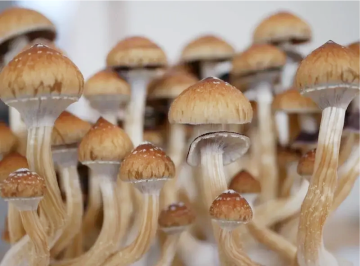
Psilocybe cubensis
Golden Teacher / Cube / African TranskeiPsilocybe cubensis — African Transkei / Cube
The world's most studied psilocybin mushroom. Golden-brown convex cap; blue bruising throughout; purple-brown spore print. The African Transkei strain was wild-collected from the Eastern Cape.
Mushroom Guru was the named spawn supplier under SAHPRA Schedule 7 Research Permit POS 266/2022/2023. Authenticated African Transkei spawn was supplied to the permit holder for licensed psilocybin research.
| Potency | High |
| Habitat | Bovine manure — tropical and subtropical pasture |
| Distribution | Worldwide tropical/subtropical; SA — Eastern Cape, KZN, Limpopo |
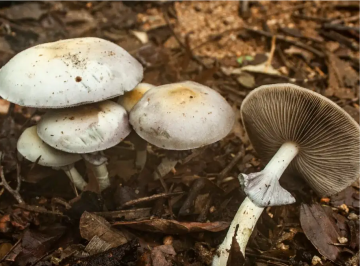
Psilocybe natalensis
Natal Super StrengthPsilocybe natalensis — Natal Super Strength
SA's first formally described native Psilocybe (1995 — Gartz, Reid, Smith & Eicker). Closely related to P. cubensis, with a less persistent ring; potency comparable.
Authenticated spawn of P. natalensis was supplied by Mushroom Guru under SAHPRA Schedule 7 Research Permit POS 266/2022/2023 — confirming SA provenance and authenticated genetics.
| Potency | High |
| Habitat | Bovine manure — KwaZulu-Natal subtropical grassland |
| Distribution | KwaZulu-Natal, South Africa — SA endemic |
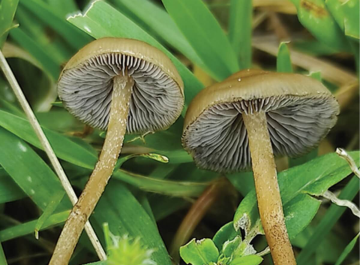
Psilocybe ingeli
IndigoPsilocybe ingeli — Indigo
One of the most significant mycological discoveries in SA history. Found in 2023 by citizen mycologist Talan Moult in KwaZulu-Natal and named for the Ingeli Mountains. Formally described in 2024 by van der Merwe et al. (Stellenbosch University) in Mycologia. Caramel-brown cap with exposed gills; bruises blue.
Its closest known relative is P. keralensis from India - a remarkable biogeographic link. Psilocybin content has not yet been formally quantified.
| Potency | Not yet quantified |
| Habitat | Bovine manure-enriched pastureland — KwaZulu-Natal highlands |
| Distribution | KwaZulu-Natal — Ingeli Mountains. SA endemic |
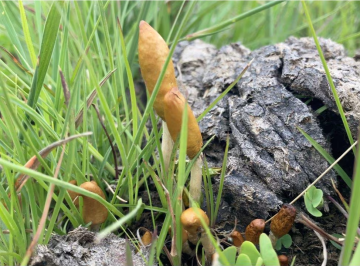
Psilocybe maluti
Maluti / Basotho MushroomPsilocybe maluti — Maluti / Basotho Mushroom
Described in 2024 by van der Merwe et al. in Mycologia. The cap usually stays closed at maturity (secotioid). Its documented use by Basotho healers is the first first-hand record of traditional psilocybin-mushroom use in Africa.
Reported use by Basotho traditional healers in Lesotho (local name koae-ea-lekhoaba). First found on a Free State smallholding in 2021 by Daniella Mulder.
| Potency | Moderate–High |
| Habitat | Bovine manure-enriched grassland — Free State highlands and Lesotho |
| Distribution | Free State, KwaZulu-Natal, Lesotho highlands. SA/Lesotho endemic |
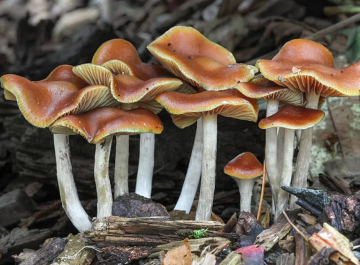
Panaeolus cyanescens
Blue MeaniePanaeolus cyanescens — Blue Meanie
A potent dung-inhabiting Panaeolus. Mottled gills (black patches from uneven spore maturation) are a feature of the whole Panaeolus genus, not of this species alone.
Bruises blue when damaged, though bruising varies. Easily confused with other Panaeolus species on the same dung; identification needs microscopy.
| Potency | High |
| Habitat | Bovine and equine manure — tropical and subtropical SA |
| Distribution | Tropical worldwide; SA — KZN, Limpopo, Eastern Cape |
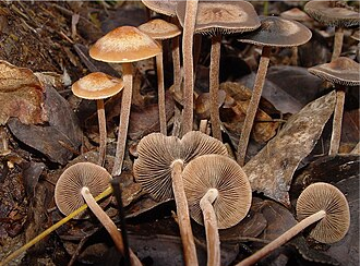
Panaeolus cinctulus
Banded MottlegillPanaeolus cinctulus — Banded Mottlegill
One of the most widespread psilocybin-containing mushrooms. Found in SA suburban gardens and parks after rain.
Psilocybin content varies enormously — some specimens contain virtually none, others are moderately active. Common in garden beds with cow manure compost.
| Potency | Mild–Moderate (variable) |
| Habitat | Dung, compost, enriched grassland — suburban SA gardens |
| Distribution | Cosmopolitan — SA gardens, parks, compost heaps |
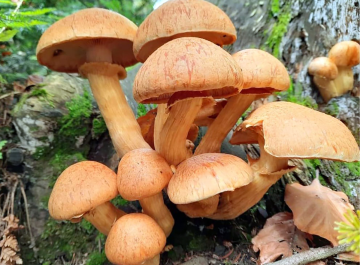
Gymnopilus junonius
Spectacular RustgillGymnopilus junonius — Spectacular Rustgill
One of the largest and most visually striking psilocybin-containing mushrooms. Brilliant golden-orange clusters on dead wood stumps. Intensely bitter taste (from gymnopilins) is a consistent field characteristic. Known as 'Owaraitake' (Big Laughing Mushroom) in Japanese ethnomycology.
Psilocybin content varies between populations - European populations generally test negative. Deadly Galerina species share its wood habitat and rust-brown spore print.
| Potency | Variable |
| Habitat | Dead stumps, logs, buried wood roots — SA parks and forests |
| Distribution | Worldwide on hardwood; common SA parks and planted forest |
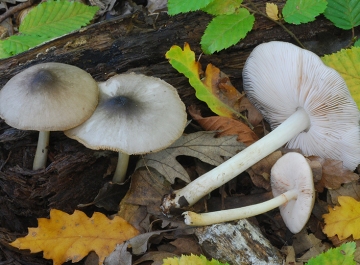
Pluteus salicinus
Willow ShieldPluteus salicinus — Willow Shield
Small grey-brown cap on dead hardwood. A pink spore print is shared by every Pluteus and by toxic Entoloma species, so it is not species-diagnostic.
Grows on dead wood rather than dung. Its occurrence in SA is poorly documented.
| Potency | Mild |
| Habitat | Dead hardwood logs, wood chip mulch, buried wood |
| Distribution | Europe and North America; SA occurrence poorly documented |
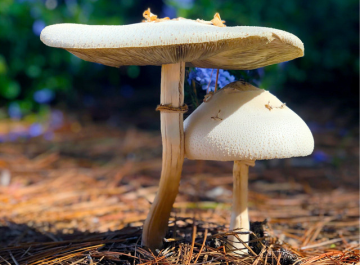
Panaeolus africanus
African MottlegillPanaeolus africanus — African Mottlegill
A documented African-distribution psilocybin Panaeolus species genetically distinct from P. cyanescens. Found on cattle and elephant dung in sub-Saharan Africa.
Part of the growing body of African psilocybin biodiversity documented through DNA sequencing. Distinguishing it from P. cyanescens requires spore print confirmation and careful habitat observation.
| Potency | Moderate |
| Habitat | Cattle and elephant dung — sub-Saharan Africa |
| Distribution | Sub-Saharan Africa including SA — documented occurrence |
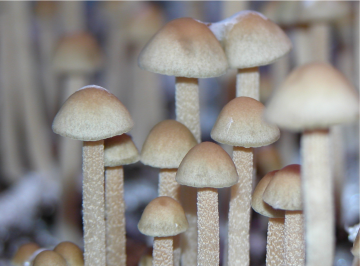
Panaeolus tropicalis
Tropical MottlegillPanaeolus tropicalis — Tropical Mottlegill
A tropical dung-inhabiting Panaeolus with documented psilocybin content. Found on cattle dung across tropical SA, overlapping habitat with P. cyanescens.
Grows in the same pasture habitat as P. cyanescens, making field separation challenging without microscopy. Often placed in Copelandia.
| Potency | Moderate–High |
| Habitat | Cattle dung — tropical and subtropical SA, KZN |
| Distribution | Tropical Asia, Africa, Americas; SA — KZN and tropical provinces |
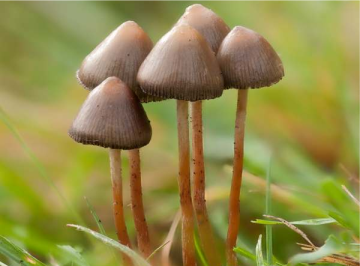
Psilocybe semilanceata
Liberty CapPsilocybe semilanceata — Liberty Cap
One of the most widely distributed psilocybin mushrooms. Conical cap, often with a sharp nipple (papilla). Among the more potent common species. Several small brown grassland species look similar, including toxic ones - no single feature is diagnostic.
Grows from dung-enriched soil rather than directly on dung. The papilla is not always present.
| Potency | High |
| Habitat | Grassland, pastures, lawns — dung-enriched soil |
| Distribution | Europe, temperate worldwide; SA records unconfirmed |
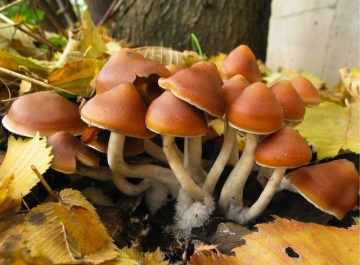
Psilocybe azurescens
Flying Saucer MushroomPsilocybe azurescens — Flying Saucer Mushroom
Among the highest psilocybin concentrations reported for any species. Described by Paul Stamets and Jochen Gartz in 1995.
Originally found along the Columbia River estuary in Oregon. Deadly Galerina species grow in similar wood-debris habitats.
| Potency | Very High |
| Habitat | Sandy coastal soil, dune grass, wood debris |
| Distribution | Pacific Northwest USA coastal dunes |
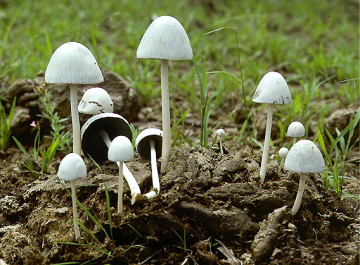
Psilocybe cyanescens
Wavy CapPsilocybe cyanescens — Wavy Cap
Cyanescens means 'becoming blue'; 'Wavy Cap' refers to the wavy cap margin. Described in 1946 from Kew, England. Has spread to gardens and parks worldwide through wood chip mulch.
Deadly Galerina species grow in the same wood-chip habitat and can look very similar.
| Potency | High |
| Habitat | Wood chips, garden mulch, conifer debris |
| Distribution | Pacific Northwest USA, Europe; spreading globally via horticulture |
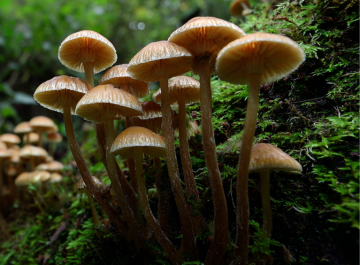
Psilocybe mexicana
TeonanácatlPsilocybe mexicana — Teonanácatl
The species from which Albert Hofmann first isolated and named psilocybin and psilocin in 1958 — the foundational event in modern psilocybin science.
Hofmann isolated psilocybin from this species in Basel in 1958. The sclerotia (underground hardened mycelium masses) contain psilocybin and form the basis of the Dutch 'magic truffle' market.
| Potency | Low–Moderate |
| Habitat | Moss, meadows, roadsides — subtropical Mexico |
| Distribution | Mexico and Central America |
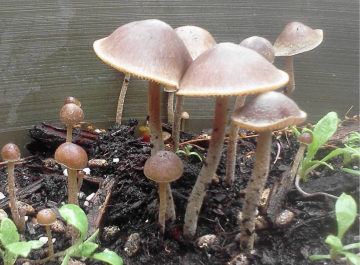
Psilocybe tampanensis
Philosopher’s StonePsilocybe tampanensis — Philosopher's Stone
Known from a single wild collection in Tampa in 1977. Produces sclerotia — the 'Philosopher's Stones' or 'Magic Truffles' that form the basis of the legal Dutch psychedelic truffle market.
The sclerotia's legal status in the Netherlands (as a natural product not covered by the original mushroom ban) created a significant legal grey area that persists today.
| Potency | Moderate |
| Habitat | Sandy soil, subtropical grassland |
| Distribution | Tampa, Florida — single wild collection 1977; widely cultivated globally |
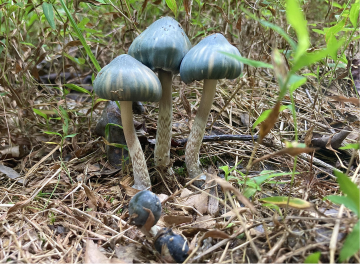
Psilocybe caerulescens
Landslide MushroomPsilocybe caerulescens — Landslide Mushroom
One of the primary ceremonial mushrooms of the Mazatec people of Oaxaca. Caerulescens means 'becoming blue'; 'Landslide Mushroom' (derrumbe) is its local common name.
R. Gordon Wasson documented its ceremonial use in 1955 (published 1957) — one of the specific species identified at the ceremony that triggered Western scientific interest in psilocybin mushrooms.
| Potency | Moderate |
| Habitat | Disturbed soil, sugarcane fields, landslide areas |
| Distribution | Mexico — Mazatec highland, Oaxaca |
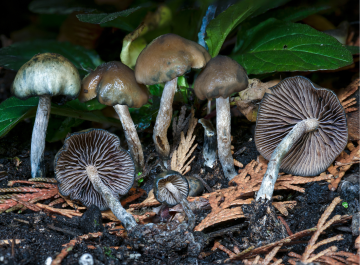
Psilocybe baeocystis
Knobby TopsPsilocybe baeocystis — Knobby Tops
Named for the discovery of baeocystin as a distinct compound within it. Distinctive pointed umbo on a hygrophanous caramel-brown cap.
The discovery of baeocystin (named after this species) contributed to understanding the full tryptamine biosynthetic pathway in psilocybin mushrooms.
| Potency | Moderate–High |
| Habitat | Bark mulch, wood chips, grassy areas |
| Distribution | Pacific Northwest USA |
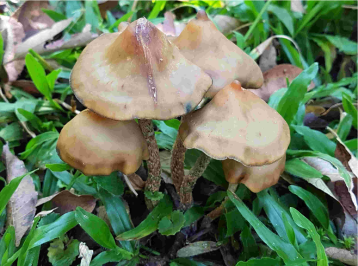
Psilocybe zapotecorum
Zapotec MushroomPsilocybe zapotecorum — Zapotec Mushroom
A large, robust Psilocybe used ceremonially by the Zapotec people of Oaxaca. Grows on wet disturbed ground near streams.
One of the larger Psilocybe species. Part of the rich Mesoamerican psilocybin mushroom ceremonial tradition.
| Potency | Moderate |
| Habitat | Swampy soil, stream banks, wet disturbed ground |
| Distribution | Mexico, Guatemala, Colombia, Brazil |
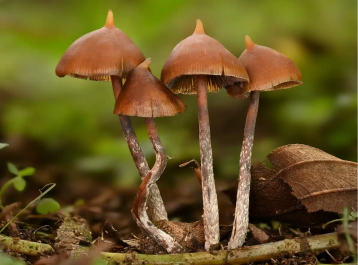
Psilocybe hoogshagenii
Little BirdsPsilocybe hoogshagenii — Little Birds
Documented from Mexico, Colombia, and Brazil. Used ceremonially by the Mixe of Oaxaca, Mexico.
The common name 'Little Birds' reflects the delicate, small-capped nature of the fruiting bodies.
| Potency | Moderate |
| Habitat | Clay soil, coffee plantations |
| Distribution | Mexico, Colombia, Brazil |
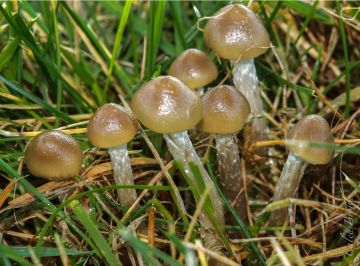
Psilocybe stuntzii
Blue RingerPsilocybe stuntzii — Blue Ringer
Named in honour of Dr Daniel Stuntz of the University of Washington. Bluish ring (annulus); bluing varies. Common in lawns and wood chips.
'Blue Ringer' refers to the bluish ring. Deadly Galerina species grow in the same wood-chip and lawn habitats and can look very similar.
| Potency | Low–Moderate |
| Habitat | Grass, lawns, wood chips — suburban gardens |
| Distribution | Pacific Northwest USA |
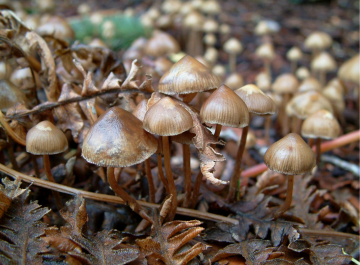
Psilocybe pelliculosa
Conifer PsilocybePsilocybe pelliculosa — Conifer Psilocybe
A small, slender species found in conifer forest duff. Notable for its conifer forest ecological niche — distinct from the dung-inhabiting majority.
Documents psilocybin in a conifer-forest niche. Deadly Galerina species share this habitat.
| Potency | Low |
| Habitat | Conifer debris, forest duff, needle mats |
| Distribution | Pacific Northwest USA conifer forests |
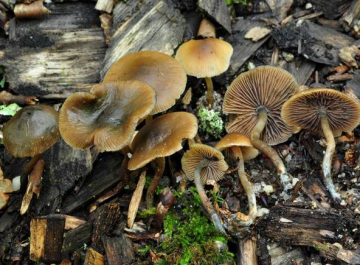
Psilocybe caerulipes
Blue-FootPsilocybe caerulipes — Blue-Foot
An eastern North American wood-decay species. Named for the blue colouration at the stipe base — an ecological parallel to SA's Pluteus salicinus.
The stipe base often stains blue when handled, though bluing alone never confirms identification.
| Potency | Moderate |
| Habitat | Decaying deciduous hardwood logs and debris |
| Distribution | Eastern North America |
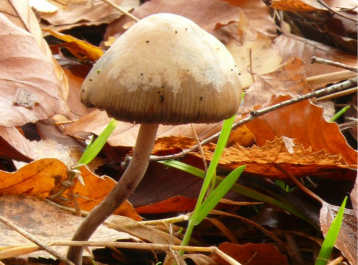
Psilocybe bohemica
Bohemian PsilocybePsilocybe bohemica — Bohemian Psilocybe
First described from Bohemia; now treated as a synonym of P. serbica (Borovička et al. 2015). One of the most potent European Psilocybe species. Found in woodland gardens and parkland with woody debris.
One of the more potent European species.
| Potency | High |
| Habitat | Wood debris, forest soil, woodland gardens |
| Distribution | Central Europe — Czech Republic, Slovakia, Germany |
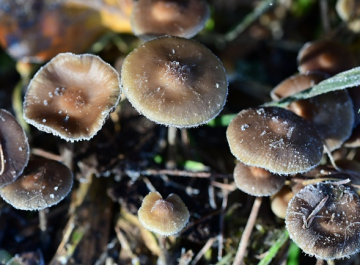
Psilocybe serbica
Serbian PsilocybePsilocybe serbica — Serbian Psilocybe
A potent Balkans species found in beech and mixed forest debris in mountainous stream-bank environments. P. bohemica is now treated as a synonym of this species.
Documents the southeastward distribution of potent European Psilocybe species into the Balkans.
| Potency | High |
| Habitat | Forest debris, stream banks, beech woodland |
| Distribution | Southeast Europe — Balkans |
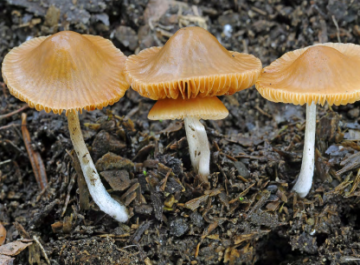
Conocybe cyanopus
Blue-Footed ConocybeConocybe cyanopus — Blue-Footed Conocybe (Pholiotina cyanopus)
A small brown lawn mushroom with a distinctive blue-staining stipe base. Contains low levels of psilocybin and baeocystin.
Closely resembles the deadly, amatoxin-containing Pholiotina rugosa (syn. Conocybe filaris), which grows in the same lawns. Blue staining is unreliable and does not separate the two - expert microscopic examination is required.
| Potency | Low |
| Habitat | Lawns, pastures, parks — nitrogen-rich soil |
| Distribution | North America, Europe |
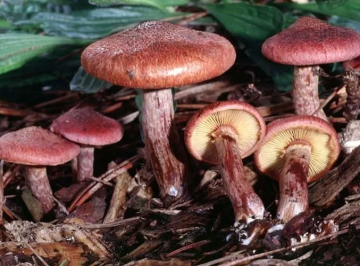
Gymnopilus purpuratus
Purple GymnopilusGymnopilus purpuratus — Purple Gymnopilus
A purple-hued Gymnopilus containing psilocybin more consistently than the variable G. junonius.
Deadly Galerina species share its wood habitat and rust-brown spore print.
| Potency | Moderate |
| Habitat | Wood, wood chips, sawdust — on dead wood |
| Distribution | South America, Europe |
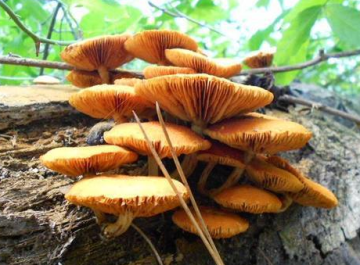
Gymnopilus aeruginosus
Magic Blue GymnopilusGymnopilus aeruginosus — Magic Blue Gymnopilus
A blue-green tinged Gymnopilus with documented psilocybin content. More consistent than G. junonius.
Its blue-green tint comes from pigments. Deadly Galerina species share its wood habitat and rust-brown spore print.
| Potency | Moderate |
| Habitat | Stumps, conifer logs, dead wood clusters |
| Distribution | Pacific Northwest USA, Japan |
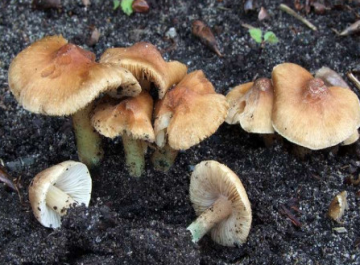
Inocybe aeruginascens
Blue-Greening InocybeInocybe aeruginascens — Blue-Greening Inocybe
The species in which aeruginascin, a trimethylated tryptamine, was first isolated (Gartz 1989); its pharmacology is poorly understood.
Most Inocybe species are toxic (muscarine); Inocybe identification requires microscopy.
| Potency | Low |
| Habitat | Sandy soil, parks, gardens, urban areas |
| Distribution | Central Europe — Czech Republic, Germany, Hungary |
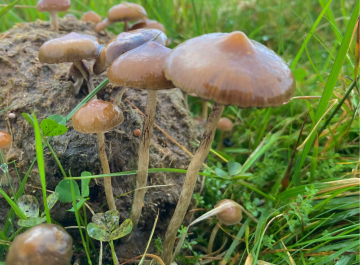
Psilocybe fimetaria
Dung-Loving PsilocybePsilocybe fimetaria — Dung-Loving Psilocybe
A northern European dung-inhabiting species ecologically similar to P. semilanceata but morphologically distinct.
P. fimetaria's direct association with dung rather than dung-enriched soil is a useful ecological distinction from P. semilanceata.
| Potency | Low–Moderate |
| Habitat | Horse and cattle dung, dung-enriched soil |
| Distribution | Northern Europe |
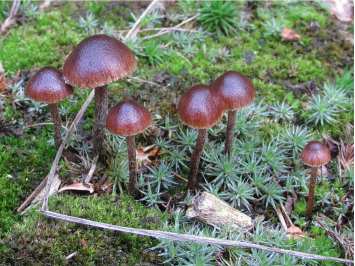
Psilocybe montana
Mountain PsilocybePsilocybe montana — Mountain Psilocybe
Found in moss and heathland, including at altitude. Psilocybin often absent or very low — primarily of taxonomic and biogeographic interest.
Documents that psilocybin biosynthesis extends to alpine environments.
| Potency | Very Low |
| Habitat | Mountain soil, moss, heathland — above 1,000m |
| Distribution | Alpine and subalpine Europe and North America |
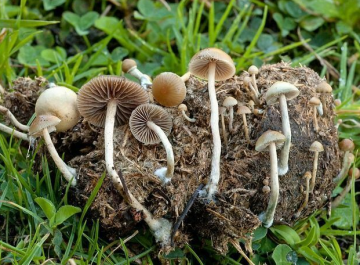
Psilocybe liniformans
Lawn PsilocybePsilocybe liniformans — Lawn Psilocybe
A European lawn species with confirmed but very low psilocybin content. Found in lawns and disturbed grassland.
Very low potency makes accidental ingestion unlikely to cause significant effects, but public safety awareness of its existence is relevant.
| Potency | Low |
| Habitat | Dung and dung-enriched grassland |
| Distribution | Western Europe, North America |
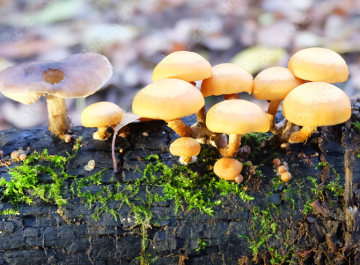
Psilocybe mairei
Maire’s PsilocybePsilocybe mairei — Maire's Psilocybe
A North African endemic Psilocybe described from grassy places in Algeria and Morocco. One of the few African psilocybin species documented before the 2023–2024 SA discoveries, alongside P. natalensis (1995).
Provides important biogeographic context for the more recent discovery of SA endemic species.
| Potency | Moderate |
| Habitat | Grassy places, North Africa |
| Distribution | North Africa — Morocco, Algeria |
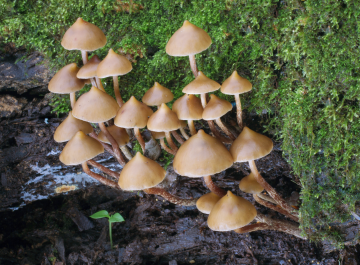
Psilocybe yungensis
Yungas PsilocybePsilocybe yungensis — Yungas Psilocybe
A cloud forest species from the Yungas of Bolivia and Peru, also recorded in Mexico.
The Yungas region supports an extraordinary diversity of psilocybin Psilocybe species.
| Potency | High |
| Habitat | Cloud forest — humid tropical montane environment |
| Distribution | Bolivia, Peru and Mexico |
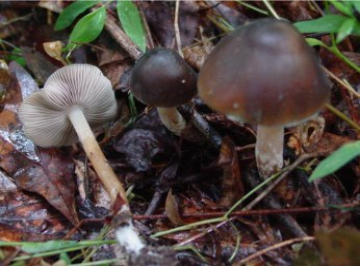
Psilocybe weilii
Weil’s PsilocybePsilocybe weilii — Weil's Psilocybe
Described in 1998 (Guzmán, Stamets & Tapia) and named in honour of Dr Andrew Weil. Found in Bermuda grass lawns and red clay soil in the southeastern United States.
The southeastern US represents an understudied region for psilocybin mushroom diversity.
| Potency | Moderate–High |
| Habitat | Red clay soil, Bermuda grass lawns, suburban parks |
| Distribution | Southeastern USA — Georgia |
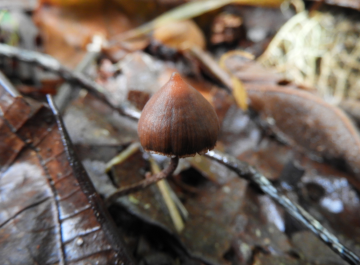
Psilocybe stametsii
Stamets’ PsilocybePsilocybe stametsii — Stamets' Psilocybe
Described in 2023 by Dentinger & Furci from cloud forest in Ecuador and named in honour of Paul Stamets. Ecology and compound profile are still being documented.
The naming of a Psilocybe species after Stamets is a fitting tribute to the mycologist whose 1996 book remains the definitive field reference.
| Potency | Unknown |
| Habitat | Cloud forest |
| Distribution | Ecuador — Los Cedros Biological Reserve |
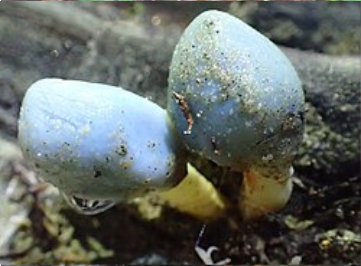
Weraroa novae-zelandiae
NZ Psilocybin SequestrateWeraroa novae-zelandiae — NZ Psilocybin Sequestrate (Psilocybe weraroa)
A remarkable species — a psilocybin-containing sequestrate (enclosed) fruiting body that never fully opens (its gill tissue stays enclosed). Now named Psilocybe weraroa. Documents that psilocybin biosynthesis has evolved in non-standard enclosed fruiting forms.
Sequestrate fungi retain an enclosed form through maturity. The presence of psilocybin in this enclosed form suggests additional biological roles beyond spore dispersal.
| Potency | Moderate |
| Habitat | Decomposing wood and forest litter |
| Distribution | New Zealand |
Psilocybe subaeruginascens
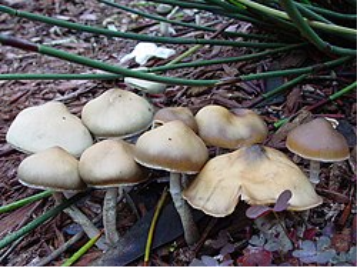
SE Asian PsilocybePsilocybe subaeruginascens — SE Asian Psilocybe
An Asian Psilocybe species. Found on dung and enriched soil in Indonesia, Japan, and surrounding regions.
Its suburban garden habitat in parts of Japan and Indonesia mirrors the distribution of P. cinctulus in SA.
| Potency | Moderate |
| Habitat | Dung, enriched soil, suburban gardens |
| Distribution | Southeast Asia — Indonesia, Japan, Philippines |
No species found — try a different search term