
Edible Mushrooms
of South Africa
A guide to wild and cultivated edible species found in South Africa - identification, season, habitat, and preparation. Click View Now on any species for full details.
Cultivated species - available to grow at home
All species below are available as professional-grade grain spawn from our 250m² GMP-audited facility in Strand. Produced on red sorghum, HEPA-filtered inoculation, dual-stage sterilisation - the same standard as our medicinal extracts. Browse all spawn →
All edible species — wild and cultivated
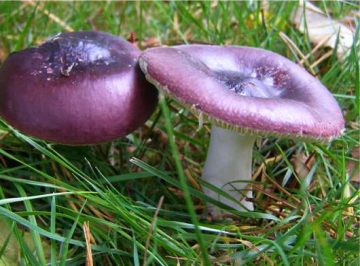
Russula capensis
Cape RussulaVivid pink-purple cap, brittle chalk-like flesh. Mycorrhizal with pine.…
Russula capensis — Cape Russula
OverviewOne of the most distinctive SA edibles - the pink-purple cap colour and chalk-white brittle flesh make it hard to confuse. The flesh snaps cleanly rather than tearing, a defining Russula characteristic. Excellent flavour when young and firm.
Identification & Traits| Habitat | Mycorrhizal under pine; Cape Peninsula and Western Cape highlands |
| Season | Autumn after rain |
| ID Features | Vivid pink-purple cap; brittle chalk-like (non-fibrous) flesh; attached gills; pale spore print; firm round shape when young |
Snap-test the flesh - a clean break confirms the genus Russula only, not edibility. Many acrid, toxic red and purple Russulas also grow under pine: taste a tiny piece and spit it out, and reject any that are peppery or bitter. Sauté in butter or add to stews. Discard any soft or worm-damaged specimens.
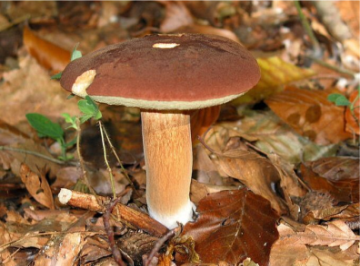
Imleria badia
Bay BoletusBay-brown cap; pores turn blue-green when bruised. Under conifers.…
Imleria badia — Bay Boletus
OverviewA reliable and flavoursome bolete found across SA's pine belt. Blue-greening of the pores when pressed is supporting evidence, not proof - many boletes bruise blue, including toxic ones - press a fingernail into the pore surface and watch for the colour change within seconds.
Identification & Traits| Habitat | Mycorrhizal under pine; SA pine plantations |
| Season | Autumn after rain |
| ID Features | Bay-brown convex cap; cream-yellow pores turning distinctly blue-green when cut or pressed; brown-streaked stipe; no ring; no volva |
Combine the bluing with a bay-brown cap that is tacky when wet and a streaked stem with no net pattern. Avoid any bolete with red or orange pores - these may be Rubroboletus satanas or related toxic boletes. Excellent sautéed or dried. Remove the sponge layer (tubes) before cooking if soft.
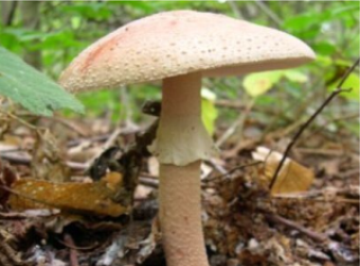
Amanita rubescens
The BlusherFlesh blushes pink-red when cut or damaged. This mushroom is toxic when raw.…
Amanita rubescens — The Blusher
OverviewFor experienced foragers only - most guides advise beginners to avoid all Amanitas. The blush reaction (flesh turning pink-red where cut or insect-damaged) is important but not enough on its own. Its dangerous lookalike is the Panther Cap (Amanita pantherina): pure white warts, a rimmed bulb at the base and no blush. Contains haemolytic compounds when raw - always cook thoroughly.
Identification & Traits| Habitat | Mycorrhizal under pine and oak; SA pine belt and planted oak landscapes |
| Season | Autumn |
| ID Features | Pinkish-brown cap with greyish-pink wart remnants; flesh turns distinctly pink-red when cut; ring on stipe; bulbous base (no volva cup); white gills blushing pink |
MUST be cooked - haemolytic when raw. Never rely on the blush alone: check for reddish stains in insect holes and at the stem base, a ring that is grooved on its upper side, and greyish or pinkish (not pure white) warts. Reject anything with pure white warts or a rimmed bulb. Never eat any Amanita raw. Avoid in damp weather when warts may have washed off and blush can be faint.
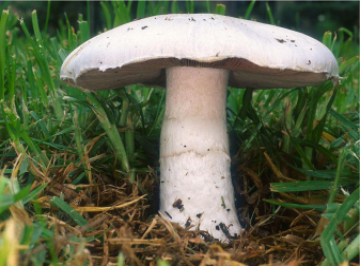
Agaricus campestris
Field MushroomClassic SA grassland mushroom. Pink gills turning chocolate-brown. Always dig up the base.…
Agaricus campestris — Field Mushroom
OverviewThe Field Mushroom is a close relative of the commercial button mushroom (Agaricus bisporus). The pink-to-brown gill colour progression is the primary identification feature - white gills in a similar-shaped white mushroom should trigger immediate caution (potential toxic Amanita or Destroying Angel).
Identification & Traits| Habitat | Grassland, pastures, parks, lawns - dung-enriched soil; SA grassland nationwide |
| Season | Summer to autumn after rain |
| ID Features | White to off-white cap; gills PINK when young turning chocolate-brown at maturity; thin white ring on the stem (fragile, often lost); NO volva at the base; spore print chocolate to purple-brown |
Critical checks: always dig out the entire stem base - any sac or cup (volva) means Amanita: discard. Gills must be PINK in buttons, never white. Check for yellow staining at stipe base - yellow staining with a phenol smell indicates the toxic Yellow Stainer. A white spore print means it is not a Field Mushroom - do not eat.
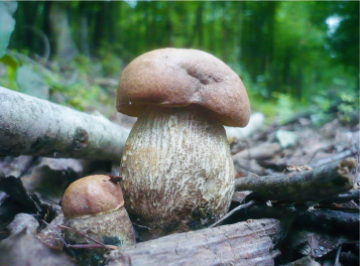
Leccinum duriusculum
Poplar BoletusGrey-brown cap with dark scabers on stipe. Exclusively under poplar trees.…
Leccinum duriusculum — Poplar Boletus
OverviewThe dark scabers on the stipe are the defining feature of all Leccinum species. The strict association with poplar trees makes this easy to confirm - if there are no poplar trees, it is not this species.
Identification & Traits| Habitat | Strictly mycorrhizal with Populus (poplar) - parks, roadsides, urban plantings |
| Season | Autumn under poplar |
| ID Features | Grey-brown to dark greyish cap; cream pores; stipe covered in dark grey-brown scabers (rough scales); flesh may turn slightly blue-grey when cut |
Cook thoroughly - some Leccinum species cause GI upset when undercooked. Darkening of the flesh and stem scales during cooking is normal for Leccinum. Excellent flavour when young and firm.
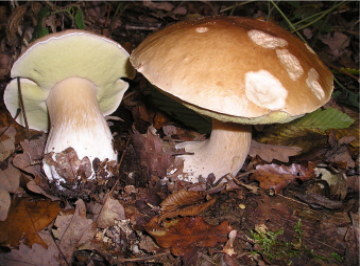
Boletus edulis
Porcini / Penny BunKing of edible mushrooms. Brown cap, reticulate stipe, cream pores. Never blues.…
Boletus edulis — Porcini / Penny Bun
OverviewThe raised white net pattern (reticulation) on the stipe near the cap is the defining mark of Porcini. Pores are cream-white and NEVER turn blue-green when cut - this is critical. Found under pine trees across SA's afforested highlands, particularly Stellenbosch mountains and KZN midlands.
Identification & Traits| Habitat | Mycorrhizal with pine, spruce, and oak; SA afforested highlands |
| Season | Autumn under pines |
| ID Features | Brown to chestnut cap; cream-white pores that NEVER turn blue; stipe with fine white net-like reticulation near cap; nutty earthy smell |
Confirmed porcini never blue. Insert a knife at the base to check for worm damage before collecting. Best dried for concentrated flavour. One of the world's most prized wild edibles - deeply savoury and nutty.
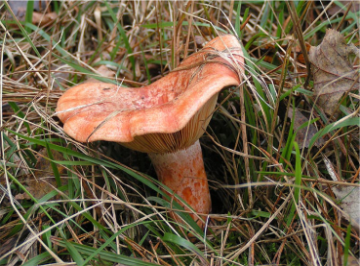
Lactarius deliciosus
Pine Ring / Saffron Milk CapBleeds carrot-orange latex. Exclusively under pine. Concentric ring zones on cap.…
Lactarius deliciosus — Pine Ring / Saffron Milk Cap
OverviewThe carrot-orange latex that bleeds from cut flesh or gills is the definitive identification feature. Bruised areas turn greenish over time - this is harmless and characteristic. Found exclusively under pine trees in SA.
Identification & Traits| Habitat | Strictly mycorrhizal with Pinus - SA pine plantations after autumn rain |
| Season | Autumn |
| ID Features | Orange-red cap with concentric ring zones; bleeds carrot-orange latex when cut; gills orange; flesh and bruises turn green over time; the latex itself stays orange (harmless) |
Roast whole in the oven with olive oil and garlic - the classic Catalan preparation. Do not boil. The orange latex confirms identity beyond doubt. One of SA's most reliably identifiable edibles.
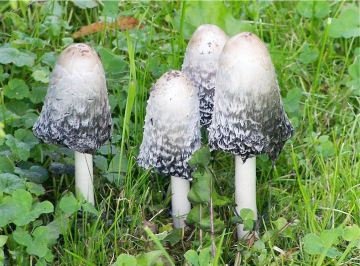
Coprinus comatus
Shaggy Ink-capMust harvest young and white — autodigests to black ink. Delicate flavour.…
Coprinus comatus — Shaggy Ink-cap
OverviewThe Shaggy Ink-cap must be harvested when still white and cylindrical - before the autodigestion (self-liquefying) process begins. Once black liquid starts forming, the mushroom is past its edible window. Delicate, mild flavour.
Identification & Traits| Habitat | Disturbed ground, lawns, road verges, compost — urban SA |
| Season | Spring to autumn after rain |
| ID Features | Tall white cylindrical cap with shaggy white scales; gills white turning pink then black; autodigests from the cap margin upward; hollow stipe; ring may be present |
Harvest only white, firm, unopened specimens. Cook within hours of picking. Do not confuse with the Common Ink-cap (Coprinopsis atramentaria) - smaller and grey-capped. The Common Ink-cap contains coprine and causes an Antabuse-like reaction when eaten with alcohol, even days later.
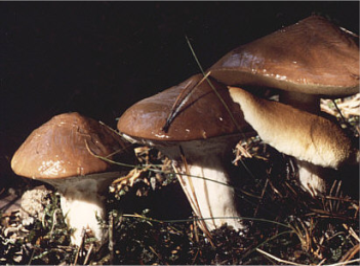
Suillus luteus
Slippery JackPersistently slimy brown cap. Yellow pores. Ring on stipe. Exclusively under pine.…
Suillus luteus — Slippery Jack
OverviewThe thick slimy coating on the cap is the primary field mark. ALWAYS peel the slimy cap skin before cooking - it causes GI upset in some people. The yellow pores and ring on the stipe distinguish it from related Suillus species.
Identification & Traits| Habitat | Strictly mycorrhizal with Pinus - very common in SA pine forests |
| Season | Autumn after rain |
| ID Features | Chestnut-brown cap with persistent slimy coating; yellow pore surface; distinctive purple-brown ring on stipe; no bluing |
Peel the slimy cap skin before cooking — essential step. Discard the tubes (sponge layer) if soft. Good flavour once cleaned. Common and abundant in SA pine forests — an accessible beginner edible.
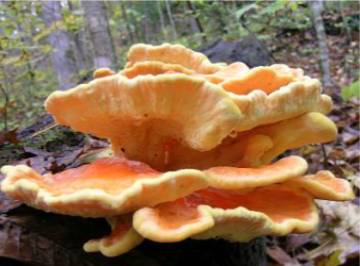
Laetiporus sulphureus
Chicken of the WoodsVivid sulphur-yellow overlapping brackets on wood. Chicken-like texture when young.…
Laetiporus sulphureus — Chicken of the Woods
OverviewOne of the most distinctive and unmistakeable edibles - the vivid orange-yellow colour and chicken-like flesh texture are unique. Some people react even to well-cooked specimens from any host - try a small portion first. Reactions are reported especially from eucalyptus, conifer and locust hosts. Do not confuse with the Jack-o'-lantern (Omphalotus), which has gills rather than pores.
Identification & Traits| Habitat | Parasitic and saprotrophic on living and dead oak, cherry, eucalyptus |
| Season | Autumn |
| ID Features | Vivid sulphur-yellow and orange overlapping bracket shelves; sulphur-yellow pore surface underneath; chicken-like texture when young; no ring or stipe |
OAK-grown only recommended. Cook thoroughly - do not eat raw. The flesh becomes tough and inedible as it ages and dries. Young specimens from oak are excellent pan-fried.
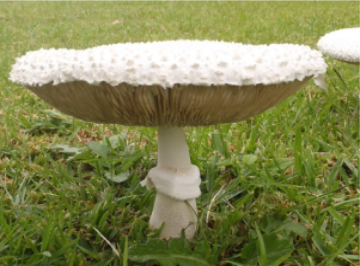
Macrolepiota procera
White ParasolLarge parasol cap up to 30cm. Snake-skin stipe pattern. Moveable ring.…
Macrolepiota procera — White Parasol
OverviewThe snake-skin pattern on the stipe and the large size make this hard to confuse. The ring is double-layered and can be slid up and down the stipe. The cap opens from a tightly closed drum-stick shape to a large flat parasol.
Identification & Traits| Habitat | Grassland, woodland edges, garden verges - SA nationwide |
| Season | Summer to autumn |
| ID Features | Large white-cream cap up to 30cm; brown central umbo; distinctive snake-skin pattern on stipe; moveable double ring; white gills; cap expands flat from a drum-stick shape |
Do not confuse with Chlorophyllum molybdites (False Parasol), common on SA lawns: its gills are WHITE when young and only turn grey-green with age, so gill colour is NOT a safe test. Always take a full spore print from a mature cap (white = parasol; green to grey-green = False Parasol). Never eat a parasol without the snake-skin stem pattern, dig up the base to rule out a volva, and never collect small parasols with caps under 10 cm (Lepiota species can be deadly). Excellent in breadcrumbs.
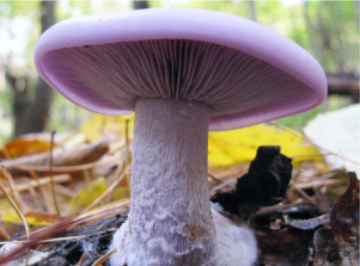
Lepista nuda
Wood BlewitDistinctive violet-purple gills and stipe. Late autumn to winter. Cook thoroughly.…
Lepista nuda — Wood Blewit
OverviewThe violet-purple colouration of cap, gills, and stipe is unmistakeable when fresh, though fades with age and in dry conditions. A welcome winter find when few other edibles are available.
Identification & Traits| Habitat | Deciduous woodland leaf litter, compost heaps, gardens - Western Cape and highlands |
| Season | Late autumn to winter |
| ID Features | Purple to blue-violet cap fading to brown; purple-violet gills fading to buff with age; purple stipe; no ring; pink-buff spore print; scented, fruity smell |
MUST cook thoroughly - contains toxic compounds destroyed by heat. Never eat raw. Take the spore print on white paper: pink-buff rules out purple Cortinarius (webcap) species, which have rust-brown prints. Faded specimens can resemble pale Clitocybe species, some of which contain muscarine - if the print is white rather than pinkish, do not eat. Excellent with cream sauce.
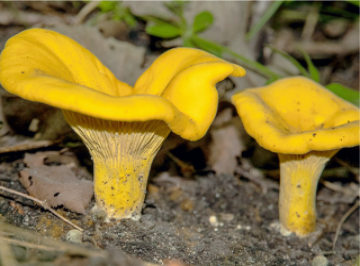
Cantharellus cibarius
Golden ChanterelleFalse forking ridges (not true gills). Apricot scent. Under pine and oak.…
Cantharellus cibarius — Golden Chanterelle
OverviewThe underside has blunt, shallow, vein-like ridges, not thin knife-edged gills. Forking alone proves nothing: the False Chanterelle (Hygrophoropsis aurantiaca), common under pine, also has forked true gills. Never collect orange "chanterelles" growing in clusters on wood or at tree bases - that pattern points to the toxic Jack-o'-lantern (Omphalotus olearius).
Identification & Traits| Habitat | Mycorrhizal under pine and oak; Western Cape pine belt and wooded ravines |
| Season | Autumn to early winter |
| ID Features | Vivid egg-yellow to orange cap; FALSE GILLS - forked ridges running down the stipe, NOT blade-like gills; funnel shape at maturity; distinctive apricot-fruity smell |
Check for blunt vein-like ridges (not thin gills), solitary growth from soil, and the apricot scent. Found under pine in SA's Western Cape highlands. Excellent sautéed in butter — world-class flavour. Do not wash - dry-brush clean.
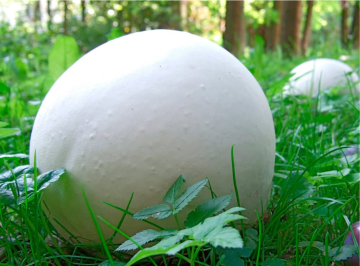
Calvatia gigantea
Giant PuffballFootball-sized white ball. Always slice top to bottom - small white balls may be deadly Amanita eggs.…
Calvatia gigantea — Giant Puffball
OverviewSlice every specimen top to bottom. The flesh must be uniformly white with no outline of a cap, gills or stem inside (that is an Amanita "egg", which can be a deadly Death Cap button) and no dark or purple tint (earthball, Scleroderma - toxic). Treat any white ball smaller than a fist as suspect.
Identification & Traits| Habitat | Open grassland, woodland edges, parks — nationwide SA |
| Season | Late summer to autumn |
| ID Features | Spherical to irregular white mass 10–60cm diameter; no cap, stipe, or gills; pure white flesh throughout when young; flesh becomes yellow then olive as spores mature |
ALWAYS slice open top to bottom: the flesh must be pure white with no internal outline of a developing mushroom. Yellow or olive interior means spores are maturing - discard. Slice like a loaf and pan-fry each slice. Excellent battered and fried.
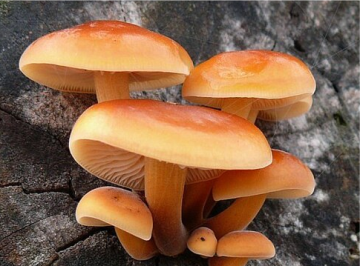
Flammulina velutipes
Velvet ShankDark velvety stipe base. Honey-coloured cap. Fruits in winter through frost.…
Flammulina velutipes — Velvet Shank
OverviewOne of the few mushrooms that fruits reliably in winter. The dark velvety stipe base against the honey-coloured cap is distinctive. The cultivated Enokitake (long white stemmed, small cap) is a variety of this same species grown in low light and CO₂.
Identification & Traits| Habitat | On dead and dying willows, elms, and hardwood stumps |
| Season | Late autumn through winter - frost tolerant |
| ID Features | Honey to tawny orange cap; gills white to pale cream; stipe dark velvety-brown at base and paler at apex; clustered growth; white spore print |
CRITICAL: Do not confuse with Galerina marginata (Deadly Skullcap), which also grows clustered on dead wood - Galerina may or may not show a ring, so the spore print is the decisive test: Velvet Shank is WHITE, Galerina is rust-brown. Also exclude Sulphur Tuft (green-yellow gills, purple-brown print). Best in soups and Asian dishes.
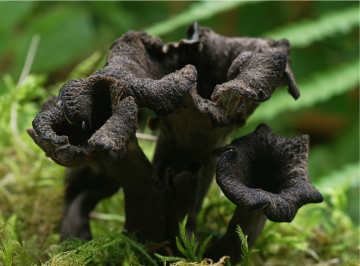
Craterellus cornucopioides
Horn of PlentyDeep black funnel with no gills. Extraordinary intense flavour when dried.…
Craterellus cornucopioides — Horn of Plenty
OverviewThe Horn of Plenty - Trompette de la Mort (Trumpet of the Dead) in France, despite its sinister name and colour, it is one of the finest edibles. No gills at all — the outer surface is smooth or very faintly ridged. Completely unmistakeable once seen.
Identification & Traits| Habitat | Deciduous woodland leaf litter - beech and oak associations in SA highlands |
| Season | Autumn |
| ID Features | Deeply funnel-shaped trumpet; grey to black; NO GILLS - smooth outer surface with faint forking ridges; hollow throughout; white to cream spore print |
Nothing else looks like this. Dried Horn of Plenty has an extraordinary, almost truffle-like intensity - excellent in sauces and risotto. Grows in beech and oak woodland in SA's higher altitude areas. Clean carefully - the funnel traps debris.
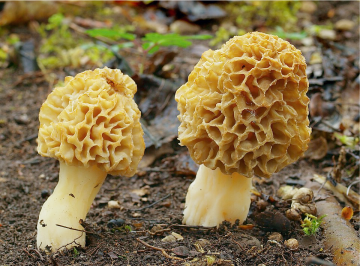
Morchella esculenta
MorelHoneycomb hollow cap. Spring fruiting. MUST COOK — toxic raw.…
Morchella esculenta — Morel
OverviewThe true Morel - completely hollow when sliced in half and the honeycomb surface - is unmistakeable. Found in SA's higher altitude grasslands and old orchards in spring. MUST be cooked: raw or undercooked morels cause GI poisoning (unidentified heat-sensitive toxins). Cook for at least 10 minutes, dried morels included, and eat moderate portions - large meals have caused neurological symptoms even when cooked.
Identification & Traits| Habitat | Disturbed ground, orchard edges, burnt areas, conifer edges - SA highlands |
| Season | Spring - short season after first warm rains |
| ID Features | Honeycomb pitted cap; completely hollow cap and stipe when sliced lengthwise; attached to stipe at base; grey to tan-brown colour |
NEVER eat raw. Always slice and inspect for hollowness throughout. Compare to False Morel (Gyromitra) - brain-like, wrinkled cap, NOT hollow inside, contains gyromitrin which cooking does not make safe - and to Verpa, whose cap is attached only at the very top of the stem. Excellent dried and reconstituted in cream sauces.
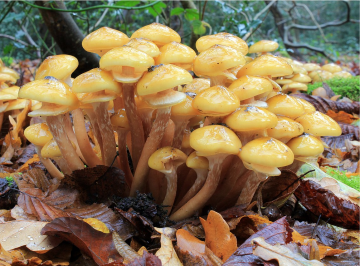
Armillaria mellea
Honey FungusClusters at tree bases. White spore print confirms. Cook thoroughly.…
Armillaria mellea — Honey Fungus
OverviewHoney Fungus is edible only when cooked thoroughly, and some people react even to well-cooked specimens - try a small amount first and avoid alcohol. A white spore print rules out the deadly Galerina marginata (rust-brown print), but NOT the toxic Jack-o'-lantern (Omphalotus olearius), which also has a pale print and grows in clusters at the base of hardwoods. Also exclude Sulphur Tuft (green-yellow gills, purple-brown print).
Identification & Traits| Habitat | In dense clusters at base of trees and stumps - SA parks and forests |
| Season | Autumn |
| ID Features | Honey-yellow to tawny-brown cap; white ring; white spore print (critical); clustered growth from common base; gills white to cream; young caps best |
A white spore print rules out Galerina (rust-brown, deadly) but not Omphalotus. Confirm a scaly cap, a ring, and black bootlace strands (rhizomorphs) under the bark; Omphalotus is bright orange, unscaled and has no ring. Discard the tough fibrous stipes — caps only. Cook thoroughly. Strong flavour when young; discard older, softer caps.
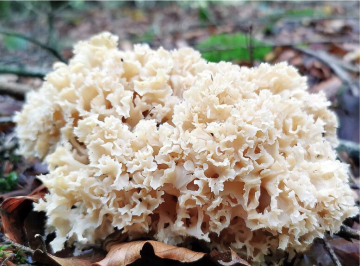
Sparassis crispa
Cauliflower FungusLarge ruffled creamy-white mass at base of pine. Also medicinally significant.…
Sparassis crispa — Cauliflower Fungus
OverviewThe Cauliflower Fungus is unmistakeable — a large ruffled brain or cauliflower-shaped mass at the base of pine trees. No dangerous lookalikes. Also medicinally significant - Sparassin (a specific beta-glucan) has been studied in cancer research.
Identification & Traits| Habitat | Parasitic at base of pine trees — SA pine plantations |
| Season | Autumn |
| ID Features | Large cream to pale yellow mass of ruffled flat lobes 15–50cm across; base firmly attached to pine roots; clean cream-white colour when fresh |
Clean thoroughly - the ruffled structure traps pine needles and debris. Best in tempura or lightly sautéed. Excellent dried. Remove any brown, tough portions - eat only the fresh cream-white lobes.
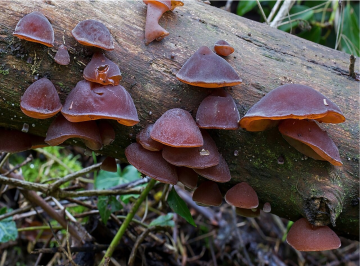
Auricularia auricula-judae
Wood EarEar-shaped gelatinous bracket on dead elder wood. Widely used in Asian cuisine.…
Auricularia auricula-judae — Wood Ear
OverviewWood Ear is the gelatinous ear-shaped fungus used widely in Chinese cuisine. Grows on dead elder wood across SA. The rubbery texture absorbs flavours from surrounding ingredients - best in soups and stir-fries.
Identification & Traits| Habitat | On dead elder, willow, and other hardwood logs - SA nationwide |
| Season | Year-round in cool moist conditions |
| ID Features | Ear-shaped gelatinous brown bracket; velvety upper surface; smooth glossy inner (lower) surface; rubbery texture; no gills; no stipe |
No dangerous lookalikes. Rehydrates fully when dried - an excellent preservation option. Commercial dried Wood Ear is usually the related Auricularia heimuer or A. cornea. Has mild blood-thinning effects - consult a doctor if you take anticoagulants.
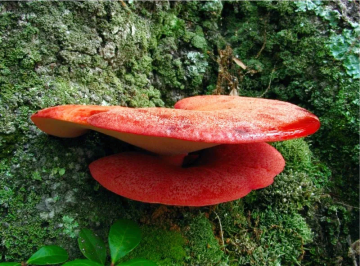
Fistulina hepatica
Beefsteak FungusBleeds red juice when cut. Tongue-shaped. On living oak. Young specimens best.…
Fistulina hepatica — Beefsteak Fungus
OverviewThe Beefsteak Fungus bleeds red juice when cut and the flesh looks remarkably like raw meat - marbled red with white fat-like veining. Found on living oak trees across SA's urban and suburban oak landscape.
Identification & Traits| Habitat | Parasitic on living oak and sweet chestnut - planted oaks across SA |
| Season | Late summer to autumn |
| ID Features | Tongue or kidney-shaped bracket; bleeds red juice when cut or scraped; upper surface smooth and moist; individual white pores visible underneath; flesh marbled red like raw meat |
Young brackets are best - pleasant sour tang, firm texture. Slice thinly and use like raw meat in salads, or cook briefly. Older brackets become leathery and bitter. The individual pores visible on the underside are a useful identification feature.
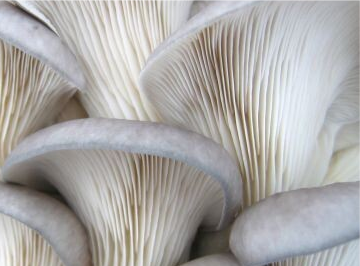
Pleurotus ostreatus
Grey OysterFruiting Temp: 18–21°C · Substrate: Wheat or barley straw…
Pleurotus ostreatus — Grey Oyster
About This SpeciesOne of the most widely cultivated mushrooms in the world. Mild anise-mushroom flavour. Fast colonising, abundant yields, tolerates a wide temperature range. Excellent sautéed or in stir-fries. Contains the beta-glucan pleuran, studied for immune-modulating activity.
Cultivation Details| Fruiting Temp | Fruiting Temp: 18–21°C |
| Substrate | Substrate: Wheat or barley straw |
| Habitat | Nutrient-rich dead hardwood, straw, coffee grounds - cultivated worldwide |
| Season | Year-round in cultivation |
| Lead Time | Approx. 1 week - fresh production per order |
| Production | Mushroom Guru 250m² GMP-audited facility, Strand, Western Cape |
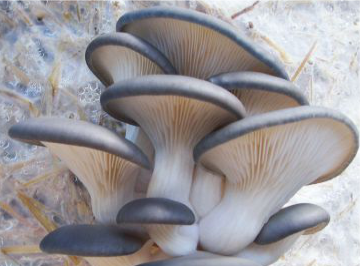
Pleurotus columbinus
Blue OysterFruiting Temp: 8–12°C · Substrate: Wheat or barley straw…
Pleurotus columbinus — Blue Oyster
About This SpeciesAstoundingly beautiful deep blue-grey mushroom. Prefers cold weather - ideal for SA winter growing. Blue colour fades slightly when cooked but flavour intensifies. Dense clusters with full yields in cool conditions.
Cultivation Details| Fruiting Temp | Fruiting Temp: 8–12°C |
| Substrate | Substrate: Wheat or barley straw |
| Habitat | Straw, hardwood - cold temperature species |
| Season | Winter fruiting in cultivation |
| Lead Time | Approx. 1 week - fresh production per order |
| Production | Mushroom Guru 250m² GMP-audited facility, Strand, Western Cape |
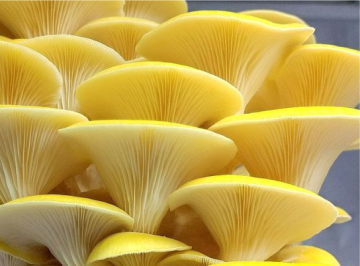
Pleurotus citrinopileatus
Golden OysterFruiting Temp: 20–28°C · Substrate: Wheat or barley straw…
Pleurotus citrinopileatus — Golden Oyster
About This SpeciesVivid yellow-gold fan clusters. Tropical species - ideal for SA summer growing. Strong fruity-anise aroma and delicate flavour. Highly ornamental and excellent fresh. Fast fruiting cycle.
Cultivation Details| Fruiting Temp | Fruiting Temp: 20–28°C |
| Substrate | Substrate: Wheat or barley straw |
| Habitat | Straw, hardwood — warm temperature species |
| Season | Summer fruiting in cultivation |
| Lead Time | Approx. 1 week — fresh production per order |
| Production | Mushroom Guru 250m² GMP-audited facility, Strand, Western Cape |
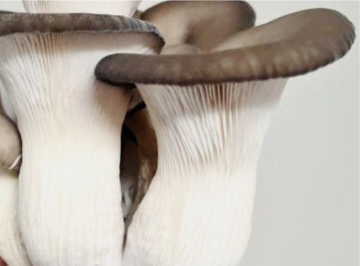
Pleurotus pulmonarius
Elf OysterFruiting Temp: 18–24°C · Substrate: Wheat or barley straw…
Pleurotus pulmonarius — Elf Oyster
About This SpeciesThe Phoenix Oyster — closely related to Grey Oyster but more heat tolerant. White to pale grey fan caps. Popular for SA summer growing where Grey Oyster underperforms. Mild flavour and good texture.
Cultivation Details| Fruiting Temp | Fruiting Temp: 18–24°C |
| Substrate | Substrate: Wheat or barley straw |
| Habitat | Straw, hardwood - wide temperature range |
| Season | Year-round in cultivation |
| Lead Time | Approx. 1 week - fresh production per order |
| Production | Mushroom Guru 250m² GMP-audited facility, Strand, Western Cape |
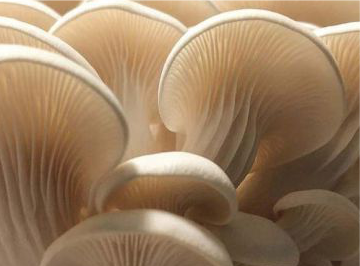
Hypsizygus ulmarius
Elm OysterFruiting Temp: 16–22°C · Substrate: Hardwood supplemented substrate…
Hypsizygus ulmarius — Elm Oyster
About This SpeciesCream-white fan caps with firm meaty texture. Higher protein content than most oysters. Slightly different appearance to true Pleurotus oysters — broader, firmer caps with more depth of flavour. Excellent shelf life once harvested.
Cultivation Details| Fruiting Temp | Fruiting Temp: 16–22°C |
| Substrate | Substrate: Hardwood supplemented substrate |
| Habitat | Dead elm and other hardwoods |
| Season | Autumn to spring in cultivation |
| Lead Time | Approx. 1 week - fresh production per order |
| Production | Mushroom Guru 250m² GMP-audited facility, Strand, Western Cape |
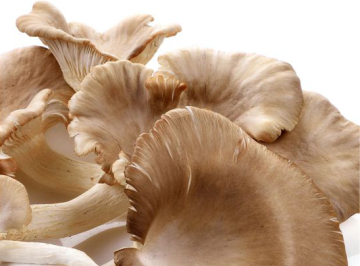
Pleurotus floridanus
Indian OysterFruiting Temp: 24–32°C · Substrate: Supplemented wheat straw…
Pleurotus floridanus — Indian Oyster
About This SpeciesTropical species adapted to high temperatures — the optimal choice for KZN and Limpopo growers. Pale grey-cream caps. Excellent performer on straw in hot, humid conditions where other oysters fail. Bold flavour.
Cultivation Details| Fruiting Temp | Fruiting Temp: 24–32°C |
| Substrate | Substrate: Wheat straw |
| Habitat | Straw substrates — tropical conditions |
| Season | Hot summer months in cultivation |
| Lead Time | Approx. 1 week — fresh production per order |
| Production | Mushroom Guru 250m² GMP-audited facility, Strand, Western Cape |
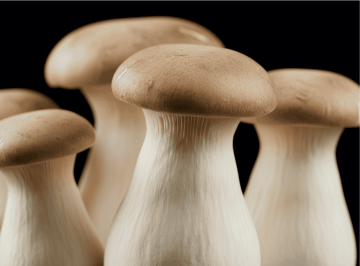
Pleurotus eryngii
King OysterFruiting Temp: 12–18°C · Substrate: Supplemented hardwood…
Pleurotus eryngii — King Oyster
About This SpeciesThe largest and meatiest of the oyster family. Thick white stipe and small brown cap - the stipe is the prized culinary portion. Slow growing but exceptional culinary value. Firm texture holds up to high-heat cooking perfectly.
Cultivation Details| Fruiting Temp | Fruiting Temp: 12–18°C |
| Substrate | Substrate: Supplemented hardwood |
| Habitat | Supplemented hardwood substrate |
| Season | Cool winter months in cultivation |
| Lead Time | Approx. 1 week - fresh production per order |
| Production | Mushroom Guru 250m² GMP-audited facility, Strand, Western Cape |
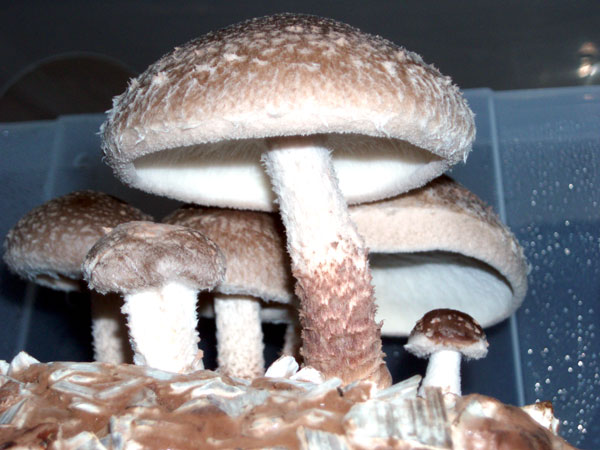
Lentinula edodes
Shiitake (Warm)Fruiting Temp: 18–25°C · Substrate: Hardwood logs or supplemented sawdust…
Lentinula edodes — Shiitake (Warm)
About This SpeciesOne of the most cultivated mushrooms in the world. Warm-fruiting LE3782 strain - ideal for SA conditions. Rich umami flavour; excellent dried. Medicinally significant - Lentinan approved as cancer adjuvant therapy in Japan. Grow on logs or hardwood substrate blocks.
Cultivation Details| Fruiting Temp | Fruiting Temp: 18–25°C |
| Substrate | Substrate: Hardwood logs or supplemented sawdust |
| Habitat | Hardwood logs (oak, poplar) or supplemented sawdust substrate |
| Season | Year-round on logs; 2–3 flushes on blocks |
| Lead Time | Approx. 1 week — fresh production per order |
| Production | Mushroom Guru 250m² GMP-audited facility, Strand, Western Cape |
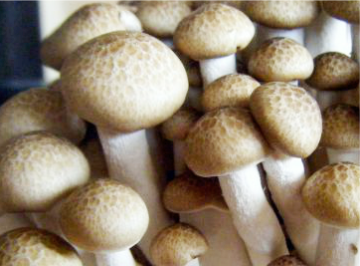
Hypsizygus tessulatus
Shimeji / Beech MushroomFruiting Temp: 13–18°C · Substrate: Supplemented hardwood…
Hypsizygus tessulatus — Shimeji / Beech Mushroom
About This SpeciesThe elegant Japanese Beech Mushroom - sold in Asian grocery stores as tight clusters of small pale caps on white stipes. Slightly bitter raw but superb when cooked - firm texture, nutty flavour. Loved in Japanese and Korean cuisine.
Cultivation Details| Fruiting Temp | Fruiting Temp: 13–18°C |
| Substrate | Substrate: Supplemented hardwood |
| Habitat | Supplemented hardwood sawdust - cool temperature species |
| Season | Cool winter months |
| Lead Time | Approx. 1 week - fresh production per order |
| Production | Mushroom Guru 250m² GMP-audited facility, Strand, Western Cape |
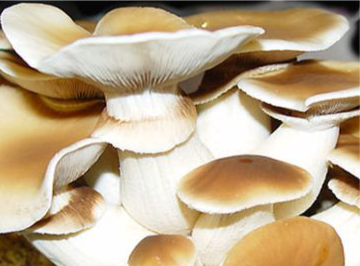
Cyclocybe aegerita
Agrocybe / SwordbeltFruiting Temp: 18–24°C · Substrate: Supplemented hardwood or straw…
Cyclocybe aegerita — Agrocybe / Swordbelt
About This SpeciesAlso known as the Black Poplar Mushroom or Velvet Pioppino. Distinctive tawny-brown caps with white-edged gills and a ring on the stipe. Firm, meaty texture with mild earthy flavour. Popular in Italian cuisine — excellent sautéed.
Cultivation Details| Fruiting Temp | Fruiting Temp: 18–24°C |
| Substrate | Substrate: Supplemented hardwood or straw |
| Habitat | Dead poplar, willow, and hardwood stumps; also on straw-based substrates |
| Season | Spring to autumn in cultivation |
| Lead Time | Approx. 1 week — fresh production per order |
| Production | Mushroom Guru 250m² GMP-audited facility, Strand, Western Cape |
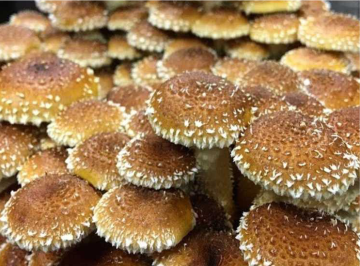
Pholiota adiposa
Chestnut MushroomFruiting Temp: 12–18°C · Substrate: Supplemented hardwood…