Medicinal Mushrooms
of South Africa
The science of functional mycology — species studied for their immune, cognitive, cardiovascular and metabolic effects. Click View Now for full compound profiles.
Medicinal mushrooms — from SA forests and cultivation
Ganoderma sichuanense & lucidum
Reishi / MG-LZ8™ GanodermaGOLD™The world's most validated mushroom. Extensive studies! Pre-clinical trial confirmed for local extract;
Ganoderma sichuanense & lucidum — Reishi / Lingzhi
Medicinal ProfileReishi is the common name for two closely related polypores: Ganoderma sichuanense (= G. lingzhi, the Asian lingzhi of traditional use) and G. lucidum, which also occurs wild in South Africa. It is an ancient, highly revered species in functional mycology. Known as the 'Mushroom of Immortality' or 'Panacea polypore', it features a deep history of therapeutic classification. The organism produces an abundance of complex structural macromolecules that support vital biological systems, rendering it a premier target species for both wild identification and intensive organic substrate cultivation.
Identification & Ecology| Habitat | Saprotrophic and weakly parasitic on dead, decaying, or dying hardwood tree stumps, roots, and logs. Found on oaks (introduced in SA) and other broadleaf trees. |
| Season | Perennial tough woody brackets found year-round in natural wild settings; dynamic growth flushes occur during warm summer periods. |
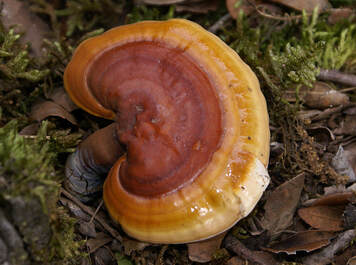
| ID Features | Distinctive laccate (shiny, heavily varnished) upper crust transitioning from deep red-maroon to a warm yellowish-white edge. Possesses a white to cream-colored fine porous underside instead of gills, dropping a rich, dense rust-brown spore cloud upon full maturity. Can develop into flat shelf brackets (conks) or multi-branched stalks depending on natural airflow conditions. |
| Triterpenoids | Over 150 lanostane triterpenoids identified, including ganoderic acids. |
| Beta-glucans | High-molecular-weight fungal polysaccharides embedded natively inside the dense, woody chitin cell wall layers. |
| Sterols & Ergosterol | Essential fungal plasma membrane components that act as natural precursor molecules to essential Vitamin D2. |
| Adenosine | Naturally occurring nucleoside compound found balanced within the dense internal structural mycelium fibers. |
Wild specimens develop incredibly tough, corky, and woody flesh making them completely unpalatable as a culinary food. Instead, the harvested brackets are collected, dried, and prepared as long-steeped traditional hot water decoctions or ethanol (drinking-grade alcohol) tinctures, often combined as a dual extract to access the locked cellular components. Mushroom Guru's MG-LZ8™ is a dual-phase extract of antler-form G. sichuanense - see the MG-LZ8™ page.
CautionsRare reports of liver injury, including with reishi powder. May interact with blood thinners, blood-pressure and diabetes medicines. Stop 2 weeks before surgery. Avoid in pregnancy. Ask your doctor first if you take immune-suppressing medication.
Trametes versicolor
Turkey TailPSK (Krestin) — approved cancer adjuvant drug in Japan since 1977. One of the most studied medicinal mushrooms.…
Trametes versicolor — Turkey Tail
Medicinal ProfilePSK (Krestin) — the polysaccharide fraction of Turkey Tail — has been an approved cancer adjuvant drug in Japan since 1977. One of the most clinically studied medicinal mushrooms. PSP, a related fraction developed in China, has also been studied for immune support alongside conventional treatment.
Identification & Ecology| Habitat | Saprotrophic — on dead hardwood stumps and logs; SA parks and forests nationwide |
| Season | Year-round; abundant after rain |
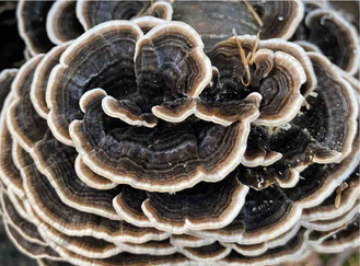
| ID Features | Thin flexible brackets with concentric colour zones (blue, brown, cream, tan); velvety upper surface; white fine pores underneath; no stipe; grows in overlapping clusters |
| PSK (Krestin) | Protein-bound beta-glucan — approved pharmaceutical in Japan for gastric cancer adjuvant therapy |
| PSP | Second protein-bound polysaccharide — NK cell and T-cell activation, immune restoration post-chemotherapy |
| Beta-glucans | Dectin-1 and TLR2 pathway activation — macrophage and NK cell priming |
| Phenolic antioxidants | Free radical scavenging — antioxidant activity |
One of the most common medicinal mushrooms in SA, on dead hardwood stumps across the country. The concentric colour-banded surface, thin flexible bracket, and fine white pores confirm identity. Not to be confused with Stereum hirsutum (False Turkey Tail) — which has a smooth pore-less underside.
CautionsSpeak to your oncologist before combining with chemotherapy. Caution with immune-suppressing medication. Side effects reported include nausea and darkened stools or nails.
Hericium erinaceus
Lion’s ManeNGF stimulation in cell and animal studies. Small trials in mild cognitive impairment.…
Hericium erinaceus — Lion's Mane
Medicinal ProfileLion's Mane contains two families of compounds - hericenones (fruiting body) and erinacines (mycelium) - that stimulate Nerve Growth Factor (NGF) synthesis in cell and animal studies. Erinacine A has been shown to reach the brain in rats; human data are limited. Small clinical trials suggest possible benefit in mild cognitive impairment, but the evidence is still limited.
Identification & Ecology| Habitat | On dead and dying hardwood — oak, beech, walnut; increasingly cultivated SA |
| Season | Autumn to winter; year-round in cultivation |
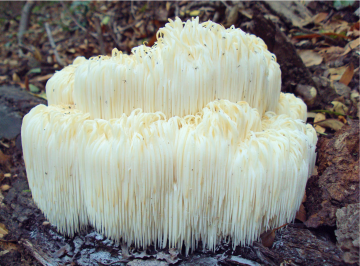
| ID Features | Cascading white spines (1–5cm long) in a globose cluster; no cap or stipe; pure white to cream when fresh; yellowing with age; distinctive cascade of icicle-like spines |
| Hericenones | Fruiting body compounds — stimulate NGF synthesis in cell studies |
| Erinacines | Mycelium compounds — stimulate NGF in animal studies; erinacine A reaches the brain in rats |
| NGF/BDNF stimulation | Studied for cognitive function and peripheral nerve repair (mostly animal data) |
| Anti-neuroinflammatory | NF-κB inhibition in microglia — neuroinflammation reduction |
| Gut-brain axis | Modulates enteric nervous system — anxiety, depression, gut motility |
No dangerous lookalikes — the cascading white spines are unique. Cultivated on hardwood sawdust or supplemented blocks. Best consumed as concentrated extract — raw powder has limited bioavailability. Both fruiting-body and mycelium extracts have been used in trials.
CautionsAllergic reactions (skin and breathing) have been reported. May affect blood clotting and blood sugar - caution with blood thinners and diabetes medicines.
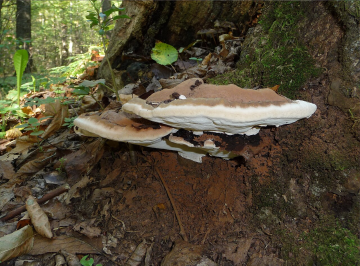
Ganoderma applanatum
Artist’s ConkFlat perennial bracket — white underside bruises brown permanently. Related bioactives to Reishi.…
Ganoderma applanatum — Artist's Conk
Medicinal ProfileA close relative of Reishi sharing the same family of ganoderic acid triterpenoids and immunomodulatory polysaccharides, though less studied. The permanently brown-bruising white underside is the primary identification feature — and the source of its common name (used by artists to draw on). Used in traditional medicine in Asia and Europe.
Identification & Ecology| Habitat | Parasitic and saprotrophic on hardwood trees — widespread in SA |
| Season | Perennial — adds a new growth layer annually; may persist for decades |
| ID Features | Flat shelf bracket; grey-brown upper surface with concentric rings; bright white underside bruises dark brown permanently when scratched (used for artwork); cocoa-brown spore cloud; hard, woody |
| Ganoderic Acids | Lanostane triterpenoids — anti-inflammatory, hepatoprotective |
| Beta-glucans | Immunomodulatory polysaccharides |
| Adenosine | Anti-platelet aggregation; cardiovascular support |
The white underside that permanently bruises brown is the definitive field mark. Draw on it with a pointed stick and the image remains. Very hard and woody — requires hot water or alcohol extraction for bioavailability. More abundant in SA than Reishi.
CautionsNo human safety data. Do not combine with germanium supplements, which have caused kidney failure.
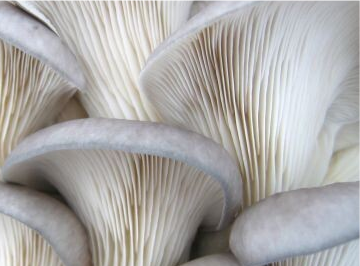
Pleurotus ostreatus
Oyster MushroomNatural lovastatin in some strains (variable). Beta-glucan pleuran — studied for immune activity.…
Pleurotus ostreatus — Oyster Mushroom
Medicinal ProfileBeyond its culinary value, some Oyster mushroom strains contain lovastatin - the same molecule as the statin drug - though amounts vary widely and are usually far below drug doses. Also contains pleuran, a beta-glucan studied for immune activity in small clinical trials.
Identification & Ecology| Habitat | Saprotrophic — on dead hardwood stumps and logs; cultivated on straw |
| Season | Year-round in cultivation; autumn to winter wild |
| ID Features | Fan or oyster-shaped brackets; grey to grey-brown; white gills running down the short stipe; white to lilac-grey spore print; mild smell |
| Lovastatin | Natural statin — inhibits HMG-CoA reductase; cholesterol reduction |
| Pleuran | Beta-1,3/1,6-glucan — clinical trials confirm immune enhancement; NK cell activation |
| Ergosterol | Vitamin D2 precursor — UV activation |
| Lovastatin (mevinolin) | Same molecule as the drug; amounts vary by strain and are far below drug doses - not a substitute for prescribed statins |
The most accessible medicinal-edible dual-purpose mushroom. Grey fan-shaped brackets with gills running down a short off-centre stem are consistent with oyster mushroom - but confirm wild specimens with an experienced identifier: toxic lookalikes on wood include Omphalotus (Jack-o'-lantern, Ghost Fungus) and Pleurocybella (Angel Wings). Cultivated on straw using the Cold Lime Soak method — see our free Level 2 training course.
CautionsNot a substitute for prescribed statins. Growers can develop a spore allergy - ventilate fruiting rooms.
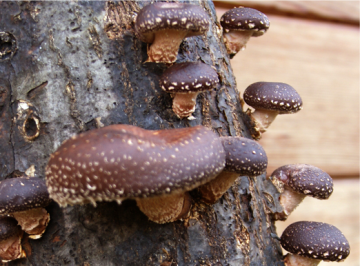
Lentinula edodes
ShiitakeLentinan — approved injectable cancer adjuvant in Japan since 1985.…
Lentinula edodes — Shiitake
Medicinal ProfileShiitake contains Lentinan — a specific beta-1,3-D-glucan that has been an approved injectable drug in Japan since 1985, given alongside chemotherapy for gastric cancer (this is not equivalent to eating shiitake). It also contains eritadenine, which reduces blood cholesterol, and multiple other bioactive compounds.
Identification & Ecology| Habitat | Saprotrophic on dead hardwood logs (oak, beech, poplar); cultivated on supplemented hardwood |
| Season | Year-round in cultivation; spring and autumn on logs |
| ID Features | Brown to tawny cap with white veil remnants on margin when young; white gills; white spore print; tough fibrous solid stipe; distinctive woody-earthy umami smell |
| Lentinan | Beta-1,3-D-glucan — approved pharmaceutical adjuvant; gastric cancer clinical trials Japan |
| Eritadenine | Purine compound — lowers blood cholesterol in animal studies by altering liver phospholipid metabolism |
Grow on hardwood logs using dowel spawn — see our free Level 1 training course. Warm-fruiting LE3782 strain available from Mushroom Guru. Excellent dried — drying concentrates umami flavour dramatically.
CautionsAlways cook: raw or undercooked shiitake can cause a whip-mark skin rash (flagellate dermatitis). Log growers can develop a spore allergy.
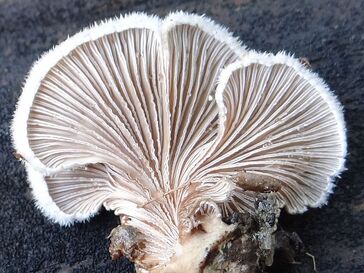
Schizophyllum commune
Split-gill PolyporeSchizophyllan (sizofiran) — approved injectable cancer adjuvant in Japan. Found on every continent bar Antarctica.…
Schizophyllum commune — Split-gill Polypore
Medicinal ProfileOne of the most widespread fungi on earth — found on every continent except Antarctica. The split gills (each gill splits lengthwise — a feature of the genus Schizophyllum) are distinctive. Contains schizophyllan (sizofiran) — a beta-glucan approved as an injectable drug in Japan since 1986, used alongside radiotherapy for cervical cancer.
Identification & Ecology| Habitat | Saprotrophic on dead hardwood — virtually any dead wood; SA nationwide and globally |
| Season | Year-round — one of the most common mushrooms in SA |
| ID Features | White to grey-white fan brackets; distinctive split gills (each gill splits longitudinally); no true pores; very common on any dead wood |
| Schizophyllan (SPG) | Beta-1,3-glucan — approved injectable adjuvant (sizofiran) for cervical cancer in Japan |
| Beta-glucans | Immunomodulatory polysaccharides — immune activation |
| Antimicrobial | Documented activity against multiple bacterial pathogens |
Very common on dead wood across SA. The split gills are the key identification feature. Tough, but widely eaten in parts of tropical Africa and Asia; usually taken as a hot-water extract.
CautionsCan cause human infection (sinus and lung) in people with weakened immune systems - avoid inhaling spores.
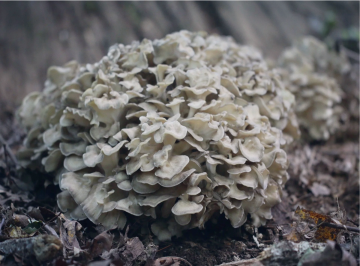
Grifola frondosa
Maitake / Hen of the WoodsD-Fraction studied in cancer clinical trials. Blood sugar effects in animal studies.…
Grifola frondosa — Maitake / Hen of the Woods
Medicinal ProfileThe Dancing Mushroom (Maitake in Japanese). D-Fraction — a protein-bound beta-glucan — has been studied in clinical trials in Japan for immune modulation alongside cancer chemotherapy. Animal and cell studies suggest effects on blood sugar regulation; human data are minimal. Grows at the base of oak trees across SA's urban oak landscapes.
Identification & Ecology| Habitat | Parasitic/saprotrophic at base of oak and other hardwoods — SA planted oak landscapes |
| Season | Autumn — large overlapping bracket clusters |
| ID Features | Large overlapping cluster of grey-brown fronds; white pore surface underneath; many short branched stems from a common base; firm texture |
| D-Fraction | Protein-bound beta-glucan — NK cell activation, studied in cancer clinical trials |
| AMPK Activation | Improved insulin sensitivity in animal studies |
| Blood Pressure | ACE inhibitory peptides — cardiovascular support |
Look at the base of oak trees in autumn. Large, overlapping grey-brown fronds with white pores underneath. Excellent eaten fresh. Do not confuse with the Giant Polypore (Meripilus), which bruises black. Also medicinally significant as a dual-purpose culinary-medicinal species.
CautionsMay lower blood sugar - caution with diabetes medicines. A raised-INR interaction with warfarin has been reported.
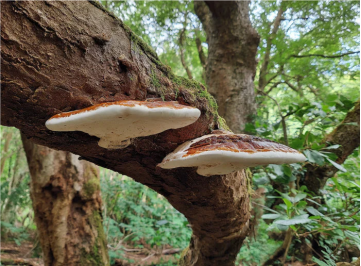
Fomitopsis betulina
Birch PolyporeCarried by Ötzi the Iceman (3,300 BCE). Antibacterial piptamine (lab studies). Traditional wound dressing.…
Fomitopsis betulina — Birch Polypore
Medicinal ProfileÖtzi the Iceman (3,300 BCE) carried two pieces of Birch Polypore threaded on leather thongs — one of the oldest archaeological records of a deliberately carried fungus. Contains piptamine (antibacterial in lab studies, mainly against Gram-positive bacteria) and polyporenic acids (anti-inflammatory triterpenoids). Traditionally used as a wound dressing and razor strop.
Identification & Ecology| Habitat | Parasitic exclusively on birch trees — SA planted birch in gardens and parks |
| Season | Perennial; year-round |
| ID Features | Smooth rounded bracket; grey-brown upper surface; white-cream underside with very fine pores; soft and spongy when young, tough when old; exclusively on birch |
| Piptamine | Antibacterial in lab studies — mainly Gram-positive bacteria and some yeasts |
| Polyporenic Acids | Anti-inflammatory triterpenoids — COX enzyme inhibition |
| Wound healing | Direct antimicrobial surface application — traditional wound dressing |
| Antiparasitic | Proposed antiparasitic use — a hypothesis for why Ötzi carried it |
Restricted to birch (Betula). Host plus features — smooth pale cap with an inrolled margin, white pores, white spore print — together support identification. Soft, white, spongy texture when young.
CautionsNo established human dosing or safety data.
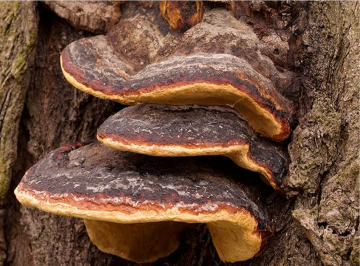
Phellinus linteus
Mesima / Black HoofHispolon — anti-tumour activity in cell and animal studies.…
Phellinus linteus — Mesima / Black Hoof
Medicinal ProfileUsed in Korean and Chinese traditional medicine (Sang Hwang). The mulberry-host species is now classified as Sanghuangporus sanghuang. Contains hispolon, which inhibits angiogenesis and induces apoptosis in cancer cell lines and animal studies; human data are lacking.
Identification & Ecology| Habitat | Parasitic on mulberry and hardwoods — SA planted mulberry trees |
| Season | Perennial bracket; year-round |
| ID Features | Hard, hoof-shaped dark bracket; velvety to cracked brown-black upper surface; rusty-brown fine pores; very hard and woody when mature |
| Hispolon | Phenolic compound — induces apoptosis and is anti-angiogenic in lab studies |
| Anti-tumour | Inhibits angiogenesis; studied in breast, colon, lung cancer |
| NK Cell Activation | Activates NK cells, macrophages, dendritic cells via polysaccharides |
| Anti-diabetic | Alpha-glucosidase inhibition — post-meal blood glucose reduction |
Hard, dark, hoof-shaped bracket on mulberry trees. Requires ethanol and hot water extraction. Not edible. A prized bracket in traditional East Asian medicine.
CautionsLittle human safety data. Caution with blood thinners and diabetes medicines.
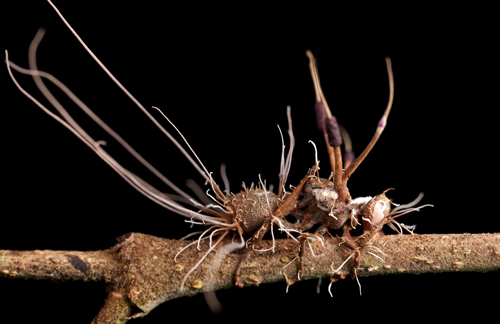
Cordyceps militaris
Scarlet Caterpillar ClubCordycepin — antiviral and anti-tumour in lab studies. Cultivated Cordyceps for SA.…
Cordyceps militaris — Scarlet Caterpillar Club
Medicinal ProfileCordyceps militaris is a cultivable relative of the Tibetan caterpillar fungus (Ophiocordyceps sinensis), though their chemistry differs - C. militaris is rich in cordycepin, which O. sinensis contains little of. Cordycepin (3'-deoxyadenosine) is an adenosine analogue with anti-tumour, antiviral and anti-inflammatory activity in lab and animal studies. Human exercise (VO₂ max) results for Cordyceps products are small and mixed.
Identification & Ecology| Habitat | Parasitic on insect pupae in soil; cultivated on grain/rice substrates SA |
| Season | Year-round in cultivation |
| ID Features | Vivid orange-red finger-like clubs 3–8cm tall from pupae; bumpy surface (perithecia); in cultivation: mass of orange clubs on grain or rice substrate |
| Cordycepin | 3'-deoxyadenosine — nucleoside analogue that interrupts RNA synthesis; anti-tumour, antiviral, anti-inflammatory in lab studies |
| VO₂ Max | Small human studies of Cordyceps products show mixed results |
| Testosterone | Stimulates Leydig cell activity — male reproductive health |
| Anti-fatigue | Reduces exercise lactate accumulation — performance and recovery |
| Antiviral | Cordycepin inhibits viral RNA replication in lab studies |
Cultivated on grain or rice substrate — vivid orange clubs are unmistakeable in cultivation. Best as concentrated extract. Antioxidant and immune activity in lab studies.
CautionsPossible blood-thinning effect - caution with anticoagulants, immune-suppressing and diabetes medicines. Avoid in pregnancy.
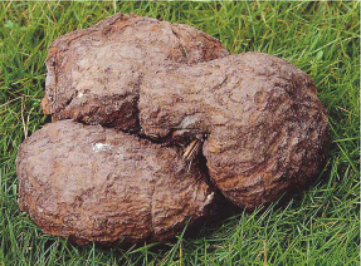
Wolfiporia cocos
Fu Ling / PoriaPachymic acids — sleep effects in mouse studies. 2,000+ years of TCM use.…
Wolfiporia cocos — Fu Ling / Poria
Medicinal ProfileA staple of Traditional Chinese Medicine with 2,000+ years of documented use. The large underground sclerotium contains pachymic acids (lanostane triterpenoids that enhanced sleep in mouse studies) and immunomodulatory beta-glucans.
Identification & Ecology| Habitat | Underground sclerotium on pine roots — SA pine plantations |
| Season | Year-round; found by probing soil at pine base |
| ID Features | Large irregular underground sclerotium (hardened mycelium mass); outer skin dark brown; inner flesh white to pale pink; no cap or gills; found on pine roots |
| Pachymic Acids | Lanostane triterpenoids — enhanced sleep in mouse studies (GABA-A pathway); no human anxiety data |
| Beta-glucans | Pachymaran — immune modulation, NK cell activation |
| Anti-anxiety | HPA axis modulation — sleep support and stress reduction |
| Prebiotic | Polysaccharides — beneficial microbiome support |
Found underground on pine roots — requires knowing where to look. Commercial Fu Ling is cultivated. Do not eat wild underground fungal masses identified on these features alone - earthballs (Scleroderma) and other underground fungi also occur under pine. Used as decoction or powder in TCM.
CautionsUse cultivated material only. Limited human safety data.
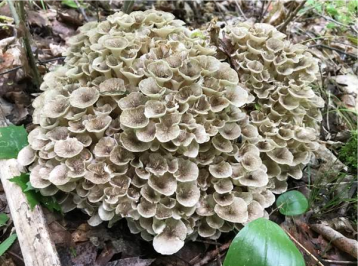
Polyporus umbellatus
Zhu Ling / Umbrella PolyporeOfficial crude drug (Chorei) in the Japanese Pharmacopoeia. Traditional urinary use.…
Polyporus umbellatus — Zhu Ling / Umbrella Polypore
Medicinal ProfileProduces a cluster of small umbrella-shaped caps from an underground sclerotium. The primary TCM mushroom for urinary tract and kidney support. The sclerotium (Chorei) is an official crude drug in the Japanese Pharmacopoeia, used in Kampo formulas such as Choreito. Ergone, a sterol in the fungus, shows diuretic activity in animal studies.
Identification & Ecology| Habitat | Underground sclerotium on tree roots; cluster of umbrella caps above ground |
| Season | Summer; cluster of small caps emerges from sclerotium |
| ID Features | Multiple small umbrella-shaped cream-brown caps from a central base; white pore surface; growing from a underground tuber-like sclerotium |
| Ergone | Sterol — diuretic (anti-aldosterone) activity in animal studies |
| Polysaccharide-D | Immunomodulatory beta-glucan — NK cell and macrophage activation |
| Diuretic | Traditional use for oedema and urinary complaints; clinical evidence limited |
| Anti-tumour | Bladder cancer studies — synergistic with chemotherapy |
The umbrella cluster of small caps emerging from soil is distinctive. Its listing in the Japanese Pharmacopoeia gives it formal official status as a crude drug.
CautionsDiuretic - caution with other diuretics, lithium, and electrolyte problems.